Properties adjoining tidal creeks and brackish wetlands across Mount Pleasant face intense biting insect pressure from late March through November. In neighborhoods like RiverTowne, Old Village, and Dune West,…
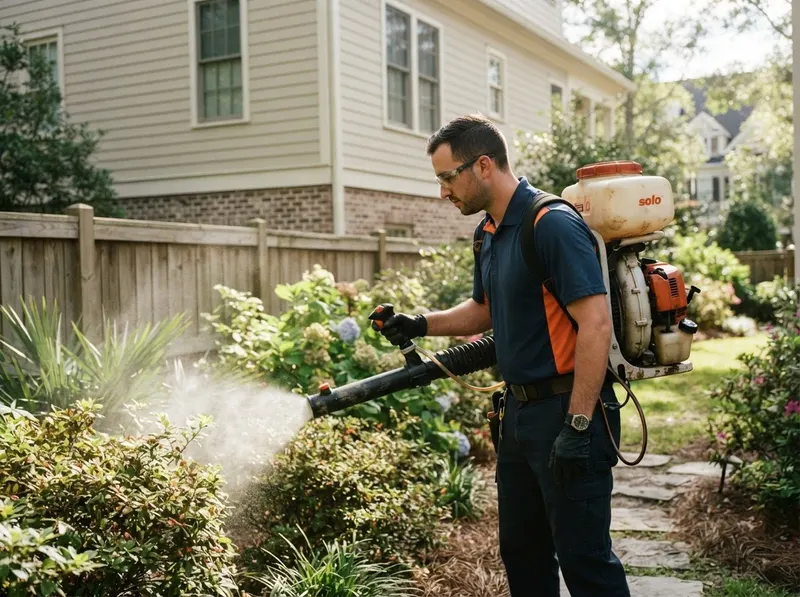
Properties adjoining tidal creeks and brackish wetlands across Mount Pleasant face intense biting insect pressure from late March through November. In neighborhoods like RiverTowne, Old Village, and Dune West, saltwater midges, locally known as no-see-ums, breed directly in moist intertidal mud, passing through standard window screens due to their sub-millimeter size (roughly 1 to 3 millimeters). Standard fogging disperses into open air within hours, whereas targeted barrier applications bind polymer-encapsulated botanicals and low-impact adulticides to the underside of wax myrtles, live oak canopies, and palmetto fronds where these weak flyers rest to escape afternoon heat.
Decision guidance depends on property layout and marsh frontage. If a parcel sits directly against pluff mud buffers in Snee Farm or Brickyard Plantation, an intensive 21-day barrier schedule with integrated biological larvicide granules (Bacillus thuringiensis israelensis) in low drainage swales stops reproductive cycles before larvae mature. Conversely, if a home is located on an interior lot in Belle Hall or Carolina Park with minimal native marsh border, a standard 30-day perimeter misting focused on foundation plantings and covered outdoor living zones provides complete relief. The trade-off centers on application frequency: humid Lowcountry rains degrade water-soluble chemicals, requiring micro-encapsulated formulations that adhere to waxy leaves during 2-inch coastal downpours rather than washing into adjacent estuaries.
The process follows four direct steps to preserve environmental balance. First, a certified technician maps non-target zones, identifying ornamental flowering beds, pollinator gardens, and open water lines to enforce strict 25-foot aquatic setbacks. Second, high-pressure backpack mist blowers deposit targeted micro-droplets directly under leaf surfaces where midges harbor. Third, standing water collection zones receive organic larvicide pucks that prevent emergence without altering water chemistry for local fauna. Fourth, homeowners receive a walk-through identifying passive moisture traps, such as bromeliad cups, saucers, and clogged perimeter gutters.
Every job gets a firm, written price after a free on-site visit.
Tell us about your mosquito & no-see-um barrier treatment job in Mount Pleasant and we'll send a clear, written quote, usually the same day.
 Harbor Pine Pest Control