Red imported fire ants (*Solenopsis invicta*) thrive in the damp, sandy loam soils typical of coastal Charleston County, constructing nests that penetrate up to 4 feet deep to track shifting water tables. In…
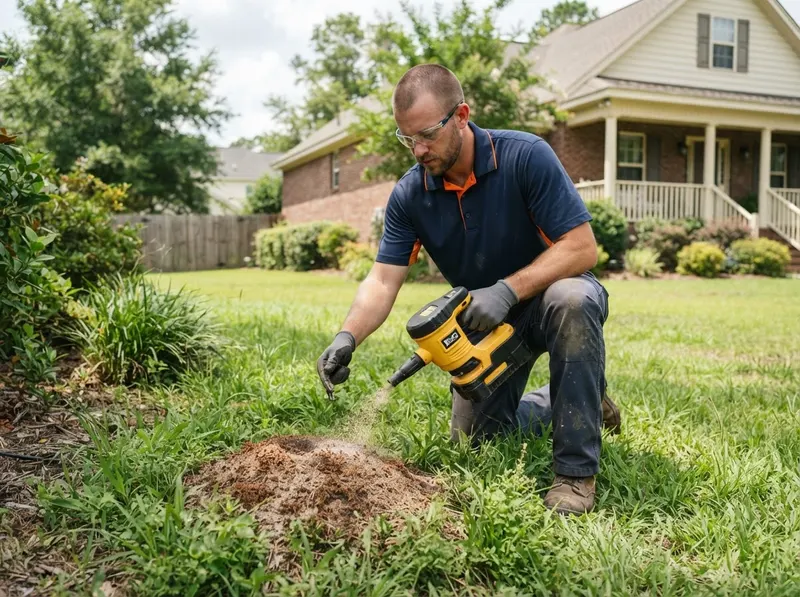
Red imported fire ants (*Solenopsis invicta*) thrive in the damp, sandy loam soils typical of coastal Charleston County, constructing nests that penetrate up to 4 feet deep to track shifting water tables. In master-planned developments like Park West, Carolina Park, and RiverTowne, subterranean colonies often establish extensive foraging tunnels beneath warm concrete driveways, brick paver patios, and turf irrigation zones. Standard surface sprays only kill surface worker ants, prompting the colony to split into multiple satellite mounds across the turf within 72 hours. Complete suppression requires an insect growth regulator (IGR) bait formulation that sterile foraging workers carry directly to the reproductive queen, systematically collapsing the colony structure over a two to three-week window.
Decision guidance depends on property size, surrounding waterways, and turf activity. For standard residential parcels up to a quarter-acre in neighborhoods such as I'On or the Old Village, individual mound injections paired with a strict perimeter barrier shield family gathering areas while respecting adjacent marsh drainage. For larger parcels ranging from a half-acre to over two acres in Dune West, Snee Farm, or Brickyard Plantation, broadcast baiting applied via calibrated spreaders ensures uniform coverage across open turf. The trade-off involves speed versus longevity: direct mound drenches yield visible knockdown within 24 hours but leave untreated margins vulnerable, whereas broadcast metabolic suppressors require 14 to 21 days for full colony collapse while delivering up to six months of documented residual protection.
Timing applications alongside coastal weather patterns determines successful control. High humidity and sudden rain along the Wando River or Shem Creek can wash away unabsorbed granular treatments, so applications align with clear 24-hour meteorological forecasts when soil surface temperatures measure between 70°F and 90°F. The process follows three distinct steps: 1. A technician walks the property to map all visible mounds, perimeter edges, and active underground foraging runs; 2. Granular baits are dispersed during peak worker foraging hours, avoiding direct mound disturbance that could trigger aggressive relocation; 3. Critical contact points near foundations, children's play sets, and patio perimeters receive low-toxicity liquid barrier applications that protect family pets once dry.
Every job gets a firm, written price after a free on-site visit.
Tell us about your fire ant mound suppression job in Mount Pleasant and we'll send a clear, written quote, usually the same day.
 Harbor Pine Pest Control